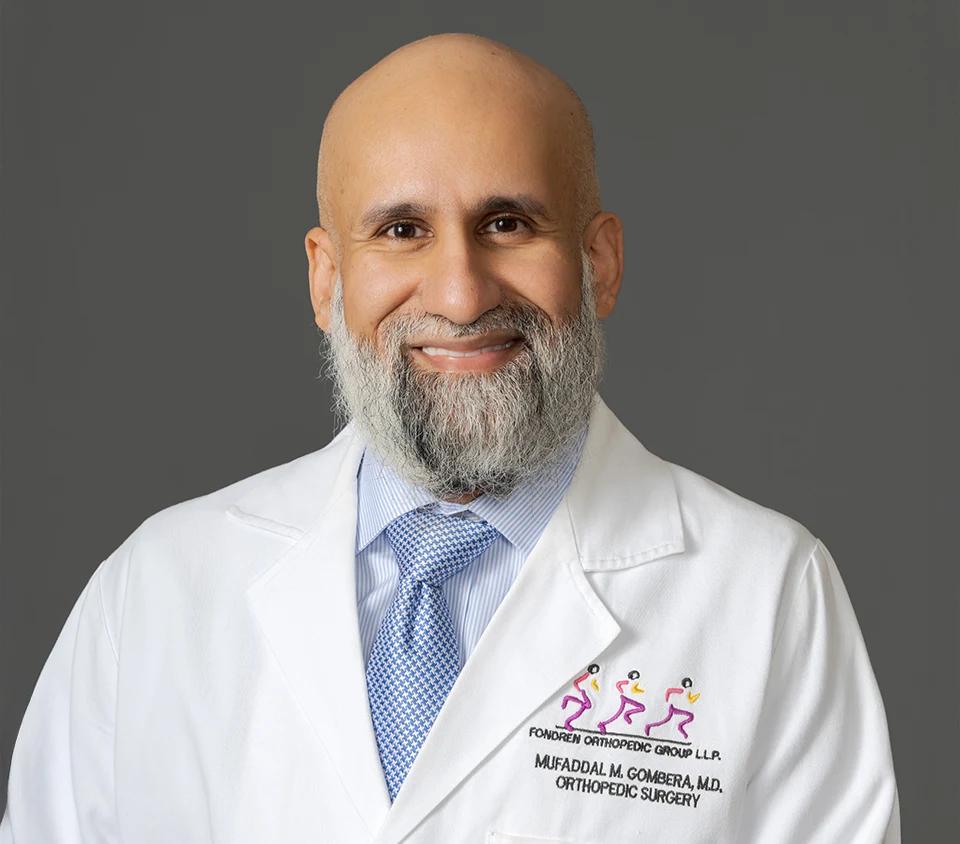
Medically reviewed by Mufaddal M. Gombera, MD, Board-Certified Orthopedic Surgeon.
Dr. Mufaddal Gombera repairs torn gluteus tendons, the rotator cuff of the hip, for patients whose outer hip pain, weakness, and limp have not responded to conservative care. He is board-certified in orthopedic surgery with subspecialty certification in sports medicine, performs more than 500 surgeries each year, and has directed the Hip Preservation Center at Texas Orthopedic Hospital since 2018.
What Gluteus Tendon Repair Fixes
Gluteus tendon repair reattaches the torn gluteus medius or minimus tendon to the greater trochanter, the bony knob on the outer hip where those tendons belong. These are the tendons that hold your pelvis level on every step; when they tear, the result is outer hip pain, weakness, and the lurching limp that gives the diagnosis away. Repair exists to fix all three, and its success depends on reattaching the tendon before the muscle deteriorates. If you have not confirmed the diagnosis yet, start with our gluteus tendon tears.
Who Is a Candidate
The best candidates have a tear confirmed on MRI, symptoms that match it, and muscle that is still healthy enough to do its job once reattached. In practice that means:
- Full-thickness tears with weakness or a limp, where the tendon will not heal on its own
- Symptomatic partial tears that have failed a genuine course of therapy, activity modification, and selective injections, often after months of treatment labeled as bursitis
- Patients motivated for a staged rehabilitation, because the recovery rewards patience
MRI findings shape the decision as much as symptoms do: tear size, retraction, and muscle quality predict how well repair will restore strength. Dr. Gombera reviews those images with you directly.
Discover Your Ortho Options
Endoscopic vs Open Repair
Both approaches reattach the tendon; they differ in access, and the tear dictates the choice.
Endoscopic repair is done through two or three quarter-inch incisions using a camera, the same minimally invasive philosophy as hip arthroscopy. It suits partial tears and smaller full-thickness tears with minimal retraction. Advantages: less soft tissue disruption, small scars, and typically less early post-operative pain.
Open repair uses a single longer incision directly over the outer hip and is the workhorse for large tears, tendons that have retracted, poor-quality tissue needing augmentation with a graft, and revision of failed prior repairs. Advantages: full visualization and the strongest possible fixation where the tissue demands it.
Neither approach is universally better; the wrong match is what fails. Dr. Gombera performs both and recommends based on your MRI, your exam, and your goals.
How Dr. Gombera Performs the Repair
The principle is the same either way: prepare the bone, then anchor the tendon back where it grew. The trochanter surface is freshened to bleeding bone, small anchors loaded with sutures are placed, and the sutures are woven through the tendon and tensioned so it sits compressed against its original footprint. Poor-quality tissue is reinforced with a graft patch. When arthroscopic joint access is needed in a combined case, Dr. Gombera uses his postless distraction setup, so no groin post is involved. Surgery is typically outpatient, with a clear written rehabilitation plan to take home.
Recovery: Honest Ranges, Not Best-Case Marketing
Gluteus tendon repair recovers on tendon-to-bone time, slower than most hip procedures, and pretending otherwise sets patients up for frustration. Two commitments protect your result: respect the protected weight bearing window of roughly 4 to 6 weeks, because tendon healing to bone cannot be rushed, then actually do the strength work from week six onward, because the muscle rebuilds only if trained. Pain relief usually arrives well before strength does; expect meaningful improvement by three months and continued gains through a year. Patients from outside Houston can complete later rehabilitation with a home therapist through our out-of-town patients pathway.
Risks, Stated Honestly
Gluteus tendon repair is safe, and complications are uncommon, but they are real: infection, blood clots, temporary numbness near incisions, stiffness, persistent weakness despite a healed repair, and re-tear, the risk of which rises with tear chronicity and poor muscle quality. Hardware irritation from anchors is rare. The honest framing is this: the operation reliably helps well-selected patients, and patient selection is precisely where the Hip Preservation Center spends its diligence. Dr. Gombera tracks patient-reported outcomes for every surgical patient, and he will tell you plainly if your tear is one that repair is unlikely to help.
Recovery After Gluteus Tendon Repair
- Day of surgery: Most patients go home the same day on crutches, with weight bearing protected to shield the repair. A hip brace may be fitted to limit stressful positions.
- Weeks 1 to 6: Protected weight bearing on crutches for roughly 4 to 6 weeks while the tendon heals to bone. Gentle guided motion begins early; active side-lifting is deliberately avoided.
- Weeks 6 to 12: Crutches are weaned and strengthening begins in earnest. Walking normalizes gradually as the abductors wake up.
- Months 3 to 6: Progressive strength work. Most patients feel steadier month by month, with daily activities comfortable and the limp resolving as strength returns.
- Months 6 to 12: Return to demanding activity, hiking, and sport as strength approaches the other side. Full recovery of strength commonly takes 6 to 12 months, honest range, not a sales pitch.
Every recovery is individualized. You will receive a written protocol, and Dr. Gombera’s team coordinates directly with your physical therapist, in Houston or at home.
Open question, see item 1. The exact protocol, protected weight-bearing duration, whether a brace is used, and side-sleeping restrictions, needs your confirmation. Placeholders of “roughly 4 to 6 weeks” and “a hip brace may be fitted” are used above pending that.
Discover Your Ortho Options
When Gluteus Tendon Repair Is Not the Right Answer
Repair depends on tissue that can heal. When a chronic tear has retracted far and the muscle has atrophied and turned fatty on MRI, reattaching the tendon is unlikely to restore strength, and Dr. Gombera will say so rather than operate on poor odds; reconstructive options such as tendon transfer, or managing with structured therapy, are discussed instead. If your pain actually comes from joint arthritis, abductor repair will not fix it, and the conversation belongs on our hip arthroscopy vs hip replacement. And bursitis without a tendon tear should be treated conservatively, not surgically.
Frequently Asked Question
Should my tear be repaired endoscopically or open?
It depends on the tear, not on preference for smaller scars. Partial and smaller full-thickness tears with good tissue suit endoscopic repair through quarter-inch incisions. Large, retracted, or revision tears usually need an open approach for a strong reattachment, sometimes with graft augmentation. Dr. Gombera performs both and matches the approach to your MRI and exam.
How long will I be on crutches after gluteus tendon repair?
Plan on roughly 4 to 6 weeks of protected weight bearing. That is longer than most hip arthroscopy recoveries, and it is deliberate: the repaired tendon must heal to bone before it is loaded, and early overloading is the most preventable cause of re-tear. You will get a written progression, not guesswork.
When can I drive after gluteus tendon repair?
Most patients drive again around 4 to 6 weeks, once they are off crutches, off narcotic pain medication, and can brake decisively without hesitation. A left-hip repair with an automatic transmission can sometimes return sooner. Test yourself in a parked car first, and never drive while taking narcotics.
How do I manage stairs during recovery?
One step at a time, with the rule: up with the good leg first, down with the crutches and surgical leg first. Use the handrail, and have someone nearby the first week. Stairs get meaningfully easier once crutches are weaned and strength work begins, typically after week six.
When can I sleep on my side again?
Most patients avoid lying on the repaired side for about 6 weeks, then resume as comfort allows, often with a pillow between the knees at first. Sleeping on the opposite side with knee support is usually fine early on. Night comfort is one of the most consistent long-term wins patients report after repair.
How successful is gluteus tendon repair?
For well-selected tears with healthy muscle, repair reliably improves pain, strength, and the limp, and published satisfaction rates are high. Results are less predictable for chronic, retracted tears with fatty muscle change, which is exactly why Dr. Gombera is candid about candidacy. He tracks patient-reported outcomes for every surgical patient.
Schedule a Gluteus Tendon Repair Consultation in Houston
Dr. Gombera sees patients at Texas Orthopedic Hospital (7401 Main St), the Memorial office (8731 Katy Freeway, Suite 110), and the Baytown office (7718 Garth Rd). Same-week consultations are available, and out-of-town patients can start with a records review.