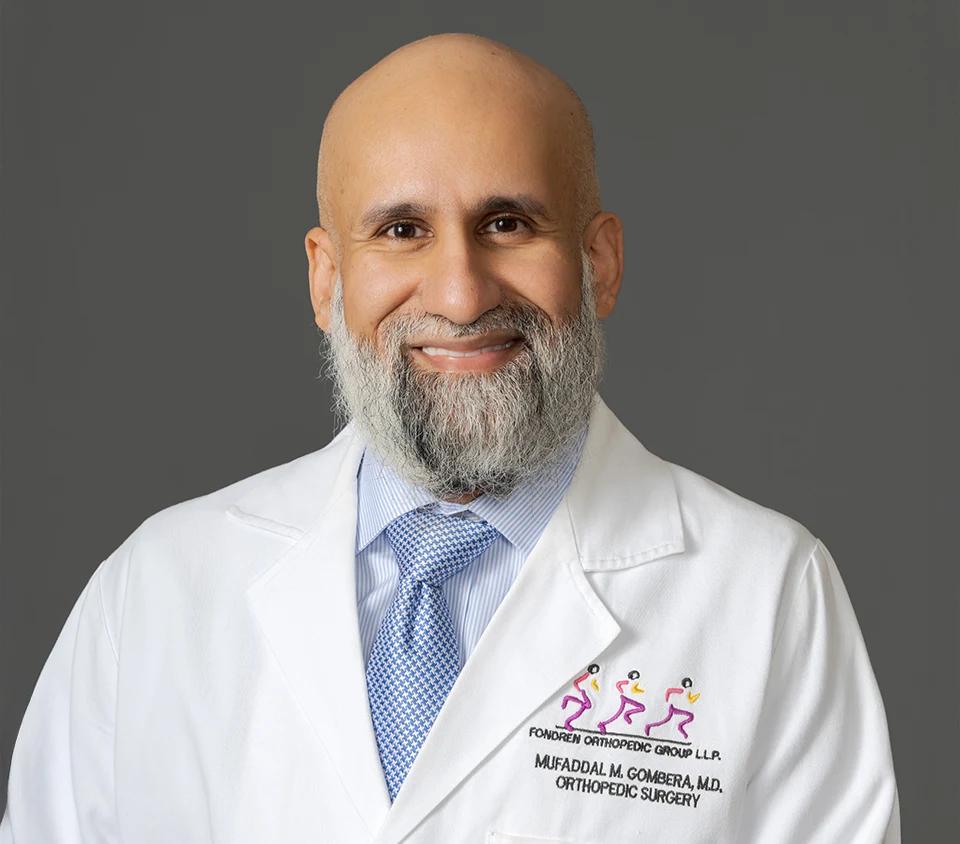
Medically reviewed by Mufaddal M. Gombera, MD, Board-Certified Orthopedic Surgeon.
Dr. Mufaddal Gombera is board-certified in orthopedic surgery with subspecialty certification in sports medicine. He served as an assistant team physician for Northwestern University football, the Chicago Cubs, and the Chicago Blackhawks during his time in Chicago, and he currently serves as a team physician for Texas Southern University, so labral injuries in overhead athletes are core territory for him. If you have deep shoulder pain, catching, or a drop in throwing velocity, this page explains the tear types and which tears should not be repaired.
What Is the Labrum?
The labrum is a ring of firm cartilage attached around the rim of your shoulder socket, deepening the shallow socket and acting like both a bumper and a suction gasket for the ball. The biceps tendon anchors into its top edge. Tears therefore cause two kinds of trouble: pain with catching or clicking, and a shoulder that may feel loose. Understanding the tear type matters more than the word “tear” itself.


SLAP Tears
You will need the Adobe Reader to view and print the above documents.
What Is the Labrum?
The labrum is a ring of firm cartilage attached around the rim of your shoulder socket, deepening the shallow socket and acting like both a bumper and a suction gasket for the ball. The biceps tendon anchors into its top edge. Tears therefore cause two kinds of trouble: pain with catching or clicking, and a shoulder that may feel loose. Understanding the tear type matters more than the word “tear” itself.
SLAP, Bankart, and Posterior Tears in Plain Language
Labral tears are named for where the ring is torn, and location predicts both symptoms and treatment.
- SLAP tears involve the top of the labrum, front to back, where the biceps anchors. SLAP stands for Superior Labrum Anterior to Posterior. They are common in throwers and lifters and cause deep pain, clicking, and lost velocity more than instability.
- Bankart tears involve the front lower rim and are the classic injury of a dislocated shoulder (/dislocated-shoulder.html). The torn bumper lets the ball slip forward again, producing shoulder instability (/shoulder-instability.html).
- Posterior labral tears involve the back of the rim. They show up in football linemen, weightlifters, and anyone loading the shoulder in a pushing position, causing deep pain and sometimes subtle instability.
Symptoms of a Labral or SLAP Tear
Labral tears typically cause deep, hard-to-localize shoulder pain with mechanical sensations. Watch for:
- Catching, clicking, popping, or grinding inside the joint
- Deep aching pain with overhead, cross-body, or pressing positions
- Loss of throwing velocity or accuracy, or a dead-arm feeling
- Slipping or looseness when tears extend toward the front or back rim
Labral Tears in Overhead Athletes
Throwers put more stress on the labrum and biceps anchor than any other athletes, which is why SLAP tears cluster in baseball, volleyball, swimming, and tennis. In throwers, Dr. Gombera is deliberately conservative: many SLAP tears respond to a program that restores rotation balance, shoulder blade mechanics, and kinetic chain strength. Surgery on a throwing shoulder is a last resort: over-tightening a thrower can end a career as surely as the tear.
How Dr. Gombera Diagnoses Labral Tears
Diagnosis combines a pattern-focused history, provocative examination tests, and contrast imaging. The exam loads the labrum and biceps anchor to reproduce your catching or apprehension. An MRI arthrogram, an MRI with contrast dye injected into the joint, outlines the labrum far better than a routine scan. Dr. Gombera interprets findings skeptically: labral fraying is common in pain-free shoulders past 40, so he treats the patient, not the picture.
Do I Need Surgery for a Labral Tear?
Most labral tears deserve a genuine trial of rehabilitation first, and the ones that need surgery need the right surgery. Therapy aimed at rotator cuff strength, shoulder blade control, and motion balance resolves symptoms for many patients within about three months. Surgery makes sense when catching persists, instability continues, or an athlete cannot return despite quality rehab.
Here is the honest part, and it matters most if you are over 40: repairing a SLAP tear in patients over about 40 often produces worse results than biceps tenodesis, with more stiffness and persistent pain. Tenodesis detaches the biceps from the torn anchor and secures it to the upper arm bone, relieving the painful tug while keeping strength. Dr. Gombera recommends tenodesis over repair when the evidence favors it, and says so directly. Surgical options include labral repair through shoulder arthroscopy, biceps tenodesis, stabilization for instability-pattern tears, and shoulder labrum reconstruction with graft tissue when a damaged labrum cannot be repaired directly. Some tears overlap with a biceps tendon injury, which changes the plan.
Discover Your Ortho Options
When to See a Doctor
See a specialist if deep shoulder pain, catching, or a feeling of slipping lasts more than two to three weeks, or immediately after any dislocation. Red flags include a shoulder that locks, repeated instability episodes, lost throwing function in a competitive athlete, and night pain with weakness, which points toward a rotator cuff tear instead. An early, accurate diagnosis prevents both unnecessary surgery and months of rehab aimed at the wrong problem.
Frequently Asked Question
What is the difference between a SLAP tear and a Bankart tear?
Both are labral tears; the difference is location and behavior. A SLAP tear is at the top of the socket where the biceps tendon anchors, and it usually causes deep pain and catching with overhead activity. A Bankart tear is at the front lower rim, happens with dislocations, and causes instability. The two are treated differently.
Can a labral tear heal on its own?
The labrum has a limited blood supply, so a torn labrum rarely reattaches itself. That said, many labral tears stop hurting with rehabilitation, because pain often comes from surrounding irritation and mechanics rather than the tear itself. If the shoulder is stable and rehab restores comfortable function, living with a torn labrum is reasonable.
What is biceps tenodesis?
Biceps tenodesis is a procedure that detaches the biceps tendon from its anchor on the torn upper labrum and secures it to the upper arm bone instead. This removes the painful tug on the damaged labrum while preserving biceps strength and appearance. For SLAP tears past 40, tenodesis often relieves pain more reliably than repair.
Why not just repair a SLAP tear in patients over 40?
Because the results are often worse. Repaired SLAP tissue in older patients tends to stiffen, stay painful, and sometimes need a second operation, and comparative studies favor biceps tenodesis for pain relief and return to activity in this group. Dr. Gombera recommends the operation with the better odds for your age and goals, not the biggest-sounding repair.
Will I throw at the same level after labral surgery?
Be cautious with any surgeon who promises this. Many athletes return to full competition after labral surgery, but throwing athletes, especially pitchers, have the least predictable return to peak velocity after SLAP repair. That is why procedure choice, rehab quality, and honest patient selection matter so much. Dr. Gombera gives you realistic numbers for your situation.
Do labral tears show up on a regular MRI?
Not always. A standard MRI can miss labral tears, so Dr. Gombera often orders an MRI arthrogram, which adds contrast dye into the joint to outline the labrum clearly. Just as important, many pain-free people have labral fraying on MRI, so the image must match your story and examination before it deserves treatment.
Schedule a Labral Tear Evaluation in Houston
Dr. Gombera evaluates labral and SLAP tears at Texas Orthopedic Hospital (7401 Main St), the Memorial office (8731 Katy Freeway, Suite 110), and the Baytown office (7718 Garth Rd). Same-week consultations are available.