Medically reviewed by Mufaddal M. Gombera, MD, Board-Certified Orthopedic Surgeon.
Dr. Mufaddal Gombera is board-certified in orthopedic surgery with subspecialty certification in sports medicine, and meniscus tears are among the most common injuries he treats. His guiding principle: preserve the meniscus whenever the tissue allows, because that cartilage protects your knee for decades. If your knee aches along the joint line, swells after activity, or catches and locks, start here.
What Is the Meniscus?
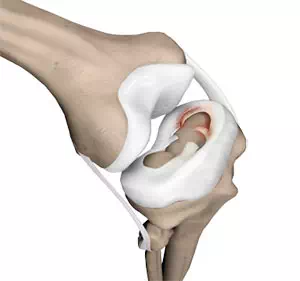
The meniscus is cartilage, not a ligament. Each knee has two menisci: C-shaped pads of cartilage that sit between the thighbone and the shinbone. They work as shock absorbers, spread your body weight across the joint, and help stabilize the knee. Lose meniscus tissue, and every step concentrates more force onto the smooth cartilage coating the bones, wearing it down years ahead of schedule.
Symptoms of a Meniscus Tear
A torn meniscus typically causes pain along the joint line, the seam between thighbone and shinbone. Swelling often builds over the first day or two rather than instantly. Many patients feel catching or clicking with bending, pain with squatting or twisting, and some cannot fully straighten it. A knee that locks, meaning it gets stuck short of straight, suggests a displaced fragment and deserves prompt attention.
Tear Patterns, and Why the Pattern Matters
The pattern and location of a tear decide whether it can heal, whether it can be repaired, and how urgent it is:
- The outer third of the meniscus has a blood supply, so tears there can heal and hold stitches well. The inner portion has essentially none, so tears there cannot heal on their own.
- A bucket-handle tear is a large flap that flips over like a handle and can lock the knee; it is often urgent and often repairable. Radial tears cut across the meniscus fibers. Horizontal and flap tears are more common in worn tissue. Root tears detach the meniscus from its anchor point on the bone, letting it squeeze out of position; it is still there, but it stops doing its job.
This is why two patients with “a meniscus tear” can get opposite recommendations. The pattern, not the label, drives the plan.
Discover Your Ortho Options
Traumatic vs Degenerative Tears
Traumatic tears happen to healthy tissue, usually from a forceful twist or a deep squat, often in younger patients and often alongside an ACL tear. These are the tears most likely to be repairable.
Degenerative tears happen because meniscus tissue weakens with age; after 40 it can tear with something as minor as rising from a squat. These tears often travel with early arthritis, and surgery is frequently not the answer: research shows many degenerative tears do just as well with structured physical therapy. Dr. Gombera will tell you honestly which kind you have.
Repair vs Meniscectomy: The Trade-Off, Honestly
When surgery is needed, there are two main options, and the trade-off deserves a plain explanation.
Meniscus repair stitches your own tissue back together so it heals. It preserves the shock absorber and protects the joint for the long term. The cost is time: repaired tissue must be protected, so recovery is slower and more restricted.
Partial meniscectomy trims out the torn fragment. Recovery is fast, often just a few weeks. The cost is permanent: removed tissue never grows back, and the more meniscus removed, the higher the long-term risk of arthritis in that part of the knee.
Dr. Gombera repairs the meniscus whenever the tear pattern and tissue quality allow, especially in younger patients, because a faster recovery today is a poor trade for a worn-out knee at fifty. When the tissue is genuinely too damaged to hold a repair, he will say so, and a careful trim becomes the right call. Both are done through knee arthroscopy.
Treatment Ladder: Conservative First
Not every tear needs an operation. First-line treatment is rest, ice, compression, and elevation, then physical therapy to restore motion and strength. Anti-inflammatory medication and occasionally an injection can settle an irritable knee. Surgery enters the conversation when the knee locks or catches, when a repairable tear is found in an active patient, or when real rehab has not settled symptoms.
Recovery: What Each Path Looks Like
After a partial meniscectomy, most patients walk the same day, return to desk work within days, and resume most activities within a few weeks.
After a meniscus repair, the timeline is phased to protect the healing tissue. In the first six weeks, you strengthen the leg in therapy while weaning off crutches and a brace. From weeks six to twelve, strengthening progresses as the brace is unlocked and retired. Between months three and six, jogging, agility work, and return to sport resume. Full recovery from a repair typically takes up to six months, and the payoff is keeping your own meniscus.
When to See a Doctor
Get evaluated promptly if your knee locks or will not fully straighten, if swelling keeps returning after activity, if joint-line pain persists beyond a couple of weeks, or if the knee catches or gives way. Early evaluation matters most for repairable tears: the longer a displaced fragment grinds in the joint, the less likely it can be saved.
Frequently Asked Question
Is the meniscus a ligament?
No. The meniscus is cartilage: a C-shaped pad of shock-absorbing cartilage between the thighbone and shinbone. Ligaments, like the ACL and MCL, are ropes of tissue that connect bone to bone. Each knee has two menisci, one on the inner side and one on the outer side.
Can a meniscus tear heal on its own?
Some can. Small tears in the outer edge of the meniscus, where there is a blood supply, can heal with time and protection. Tears in the inner portion have no blood supply and do not heal on their own, though not all of them need surgery.
What is the recovery difference between repair and removal?
Meniscus repair takes up to six months of phased recovery because the stitched tissue must heal. Removing the torn piece (meniscectomy) has patients back to most activities within a few weeks, but it permanently reduces the knee’s shock absorber.
Will removing part of my meniscus give me arthritis?
It raises the risk. The more meniscus tissue removed, the more force each step puts on the cartilage surfaces, and long-term arthritis risk rises with it. That is exactly why Dr. Gombera repairs the meniscus whenever tissue quality allows.
Do degenerative meniscus tears need surgery?
Usually not as a first step. Tears from age-related wear often calm down with physical therapy, activity changes, and sometimes an injection. Surgery is reserved for tears that keep catching or locking, or that stay painful despite a real course of rehab.
What does a locked knee mean?
A locked knee cannot fully straighten because a torn piece of meniscus has flipped into the joint and is blocking it, like a doorstop. A locked knee should be evaluated promptly, because early treatment protects the tissue and may keep it repairable.
Schedule a Meniscus Tear Evaluation in Houston
Dr. Gombera evaluates meniscus tears at Texas Orthopedic Hospital (7401 Main St), the Memorial office (8731 Katy Freeway, Suite 110), and the Baytown office (7718 Garth Rd). Same-week consultations are available.