
Medically reviewed by Mufaddal M. Gombera, MD, Board-Certified Orthopedic Surgeon.
A multi-ligament knee injury is the most serious ligament problem a knee can have, and it is handled differently from a single torn ligament starting in the first hours. Dr. Mufaddal Gombera is board-certified in orthopedic surgery with subspecialty certification in sports medicine, fellowship training that centers on exactly these complex knee reconstructions. If your knee was injured in a crash, a hard fall, or a violent tackle and feels grossly unstable, this page explains what needs to happen, in what order, and why.
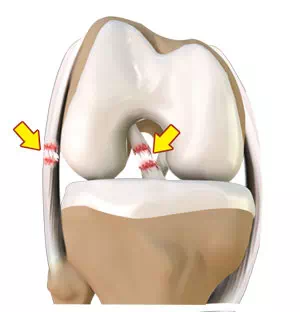
What Is a Multi-Ligament Knee Injury?
A multi-ligament knee injury means two or more of the knee’s major stabilizers tore at once: the ACL, PCL, MCL, LCL, or the posterolateral corner, a complex of small ligaments and tendons at the back outer corner of the knee. Many of these injuries represent a knee dislocation, a knee that slid fully out of joint and back in. Even when the knee looks normal by the time you reach a doctor, the injury is treated with the seriousness of a dislocation.
Why It Is Urgent: Arteries and Nerves First
Before any conversation about ligaments, the blood vessels and nerves have to be cleared, because they are what make this injury dangerous. The artery that supplies the lower leg runs directly behind the knee, held close to the bone. A knee that dislocates can stretch or tear it, and a missed artery injury can threaten the leg itself. That is why a suspected dislocation means an emergency room visit the same day, pulse checks, and frequently a CT angiogram, a scan that confirms blood is flowing normally behind the knee.
The peroneal nerve, which wraps around the outside of the knee, is also vulnerable. Numbness on the top of the foot or trouble lifting the foot (foot drop) signals nerve injury and changes the plan. None of this is meant to frighten you; it is the checklist that keeps a bad knee injury from becoming a worse leg injury.
How These Injuries Happen
Most multi-ligament injuries are high energy: car and motorcycle crashes are the most common cause. Sports produce them too, in football pileups, skiing falls, and awkward high-speed collisions. They also occur in low-energy falls, particularly in heavier patients, where body weight alone supplies the force. The spectrum runs from two torn ligaments with normal vessels to a full dislocation with artery involvement, and treatment urgency runs the same spectrum.
Planning the Reconstruction: Timing and Staging
With multi-ligament injuries, sequencing decisions matter as much as the surgery itself. Some structures are best repaired early, within about three weeks of injury, before scar tissue makes direct repair impossible. The posterolateral corner is the clearest example: it is the structure most often missed or neglected, and late diagnosis produces predictably worse results. Other ligaments, like the ACL and PCL, are typically reconstructed with grafts, from your own tissue or donor tissue, and can be timed around swelling and motion.
Because operating on everything at once can overwhelm a swollen, injured knee, Dr. Gombera often stages the work deliberately: repair the time-sensitive structures early, restore motion, then reconstruct the remaining ligaments at a second procedure. Grafts are secured in bone tunnels with fixation devices while they heal, the same principles used in ACL reconstruction, multiplied across several structures. Every plan is custom, because no two combinations of torn ligaments are alike.
Recovery: The Honest Timeline
This is a long road, and pretending otherwise helps no one. Expect crutches for six to eight weeks, a brace, and months of structured physical therapy. Stiffness is the constant enemy after multi-ligament surgery, so early guided motion is built into the plan and matters as much as protecting the repairs. Return to demanding sport or physical work often takes 9 to 12 months, sometimes longer.
The realistic goal is a stable, trustworthy knee that lets you live and work without fear of it giving way. Most patients get there, and early, well-sequenced treatment also slows the rapid march toward arthritis that neglected instability causes. An MCL component often heals with bracing while the rest is addressed surgically, which is one more reason accurate diagnosis of every injured structure comes first.
When to Seek Care Immediately
Go to an emergency room now, not tomorrow, if the foot on the injured side is cold, pale, or numb, if you cannot lift your foot, if the knee looks deformed, or if the knee dislocated at any point, even if it went back in on its own. After the emergency evaluation, see a knee reconstruction specialist within days: the window for repairing certain structures closes at about three weeks, and using it well changes outcomes.
Discover Your Ortho Options
Frequently Asked Question
Is a multi-ligament injury the same as a dislocated knee?
They overlap heavily. Tearing two or more major ligaments often means the knee dislocated, even if it slid back into place on its own before anyone saw it. That is why these injuries get the same urgent artery and nerve checks as a documented dislocation.
Why do I need a scan of the artery behind my knee?
The artery supplying the lower leg runs directly behind the knee, and a dislocating knee can stretch or tear it. A missed artery injury can threaten the leg itself, so pulse checks and often a CT angiogram are done the same day. It is a safety check you do not skip.
Can all the ligaments be fixed in one surgery?
Sometimes, but often the plan is staged deliberately: certain structures are repaired early, within about three weeks, while others are reconstructed later once swelling, skin, and motion allow. The sequencing is customized to your exact combination of injuries.
How long is recovery from a multi-ligament knee reconstruction?
This is a long road, honestly. Crutches for six to eight weeks, months of structured therapy, and a return to demanding sport or work often takes 9 to 12 months, sometimes longer.
Will my knee ever feel normal again?
The honest answer: a knee that dislocated rarely feels identical to the one before it. The realistic goal is a stable, trustworthy, pain-controlled knee, and most patients get there. Many return to sport and demanding work; some choose to modify activities.
What should I do if my knee dislocated and popped back in?
Go to an emergency room the same day, even if the knee looks normal again. The artery and nerve checks matter most in exactly this situation. Then see a knee reconstruction specialist within days, because early repair windows close quickly.
Schedule a Multi-Ligament Knee Consultation in Houston
Dr. Gombera plans and performs complex knee ligament reconstruction at Texas Orthopedic Hospital (7401 Main St), with clinics at Memorial and Baytown. Bring your imaging; same-week consultations are available.