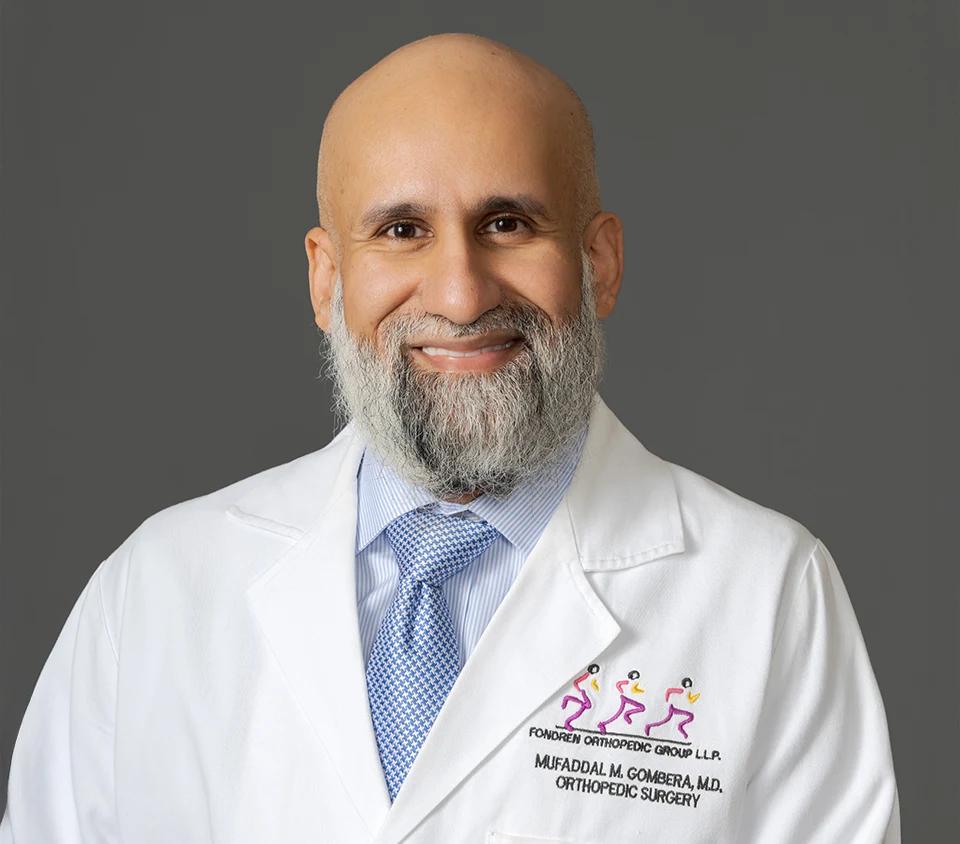
Medically reviewed by Mufaddal M. Gombera, MD, Board-Certified Orthopedic Surgeon.
PCL tears are the quiet cousin of ACL tears: less dramatic at the moment of injury, easier to miss, and more often treatable without surgery. Dr. Mufaddal Gombera is board-certified in orthopedic surgery with subspecialty certification in sports medicine, and he treats the full range of PCL injuries, from bruised ligaments that heal in a brace to combined injuries that need reconstruction. If your knee hit a dashboard, the ground, or another player, here is what to know.
What Is the PCL?
The PCL, or posterior cruciate ligament, crosses behind the ACL in the center of the knee and connects the thighbone to the shinbone. Its job is the mirror image of the ACL’s: it stops the shinbone from sliding backward. It is the thickest, strongest ligament in the knee, which is why it usually takes a direct blow to tear it.
The Dashboard Injury: How PCL Tears Happen
The classic PCL injury is the dashboard mechanism: in a car crash, the bent knee strikes the dashboard, driving the shinbone straight backward and tearing the ligament. The same force shows up elsewhere: falling hard onto a fully bent knee, or a blow to the front of the shin in football or soccer. Because the mechanism is a knee striking something, PCL tears in accidents often travel with other injuries, which is one reason every crash-injured knee deserves a careful exam.
Symptoms: Why PCL Tears Get Missed
PCL tears are quieter than ACL tears, and that is exactly why they get missed. There is often no pop. Swelling is usually milder. Many people walk afterward and assume they escaped with a bruise. The clues are a deep ache or pain toward the back of the knee, discomfort kneeling, a vague wobble rather than dramatic buckling, and unsteadiness going down stairs or hills, where the PCL works hardest. An untreated tear can quietly overload the kneecap and inner knee for years before it declares itself.
Why Many PCL Tears Are Managed Without Surgery
Most isolated PCL tears heal without an operation, and that is not settling for second best. The PCL has a better blood supply and healing environment than the ACL, and the quadriceps muscle can be trained to actively do part of the ligament’s job, pulling the shinbone forward with every step. Treatment for isolated tears combines a brace that supports the shinbone from behind while the ligament heals with rehab built around quadriceps strengthening. Grade 1 and 2 tears do reliably well this way, and many complete tears do too.
Discover Your Ortho Options
When Reconstruction Makes Sense
Surgery earns its place in three situations. First, combined injuries: a PCL torn alongside other ligaments, which is treated as a multi-ligament knee injury with different urgency and planning. Second, high-grade tears that leave the knee unstable despite a genuine course of bracing and rehab. Third, high-demand athletes or workers whose knees keep failing them on hills, stairs, and cutting. Because torn ligament ends cannot simply be sewn together, reconstruction rebuilds the PCL with a tendon graft, placed arthroscopically, similar in concept to ACL reconstruction.
Recovery Expectations, Honestly
Non-surgical treatment is not a shortcut: expect several weeks in a brace and around four months of progressive rehab before demanding activity, with the quadriceps as the centerpiece throughout. After reconstruction, the timeline stretches considerably, and return to sport can take up to twelve months. The knee is protected longer than after ACL surgery because gravity itself sags the shinbone backward against the healing graft. Bracing choices matter here; see the knee brace guide for how support differs by injury.
When to See a Doctor
Tears of the posterior cruciate ligament can be painful and deserve careful treatment. If you need treatment for a PCL tear in Houston, Texas, come to Mufaddal Gombera, MD. Through consistently exceptional care, Dr. Gombera has earned the designation of Texas Super Doctors Rising Star three years in a row.
To book an appointment, call (713) 794-3457 or use the online scheduling form to choose a time and date for your consultation.
Frequently Asked Question
Do PCL tears heal on their own?
Many do. The PCL has a better healing environment than the ACL, so isolated grade 1 and 2 tears, and even many complete tears, heal well with a brace that supports the shinbone and rehab focused on quadriceps strength.
How do I know if I tore my PCL?
Often you do not, at least not right away. PCL tears usually cause milder swelling than ACL tears and often no pop. Clues include pain deep in or behind the knee after a blow to the shin, and a knee that feels unsteady going down stairs or hills.
When does a PCL tear need surgery?
Reconstruction is recommended when the PCL tears alongside other ligaments, when a high-grade tear leaves the knee unstable despite a real course of bracing and rehab, or in high-demand athletes and workers whose knees keep giving trouble.
What happens if a PCL tear goes untreated?
-
A loose PCL lets the shinbone sag backward, which overloads the kneecap and the inner compartment of the knee. Over years, that extra load can wear down cartilage. Proper bracing and rehab early is how that path gets avoided.
How long is recovery from a PCL injury?
Non-surgical treatment typically takes around four months of bracing and progressive rehab before returning to demanding activity. After PCL reconstruction, recovery is longer, and a return to sport can take up to twelve months.
What is the difference between an ACL and a PCL tear?
They are the two ligaments crossing in the center of the knee. The ACL stops the shinbone sliding forward and tears with pivots and landings. The PCL stops it sliding backward and tears with direct blows to the shin. PCL tears are less common and more often managed without surgery.
Schedule a PCL Evaluation in Houston
Dr. Gombera evaluates PCL injuries at Texas Orthopedic Hospital (7401 Main St), the Memorial office (8731 Katy Freeway, Suite 110), and the Baytown office (7718 Garth Rd). Same-week consultations are available.