Medically reviewed by Mufaddal M. Gombera, MD, Board-Certified Orthopedic Surgeon.
Knee arthroscopy fixes mechanical problems inside the knee, torn meniscus tissue, cartilage flaps, and loose fragments, through incisions about a quarter of an inch long. Dr. Mufaddal Gombera is board-certified in orthopedic surgery with subspecialty certification in sports medicine and performs more than 500 surgeries each year. He is equally direct about what a scope cannot fix, which is why some consultations end with a recommendation not to operate.
What Is Knee Arthroscopy?
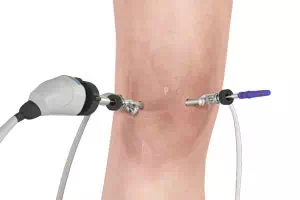
Knee arthroscopy is minimally invasive surgery performed through two or three quarter-inch incisions. A pencil-sized camera called an arthroscope projects a magnified view of the joint onto a monitor while precise instruments do the work: trimming, stitching, or removing damaged tissue. Because the knee is not opened, most patients go home the same day, hurt less, and recover faster than with open surgery.
What Knee Arthroscopy Treats
Arthroscopy earns its keep against mechanical problems, physical pieces of tissue catching, locking, or grinding inside the joint:
- Meniscus tears. Repaired with stitches when tissue quality allows, trimmed when it does not. The repair-versus-removal trade-off is explained honestly on the meniscus page.
- Cartilage flaps and defects. Loose flaps are smoothed, and isolated cartilage injuries can be treated with restoration procedures, several of which begin arthroscopically.
- Loose bodies. Fragments of cartilage or bone floating in the joint, causing catching and locking. Removal is quick and gratifying.
- Ligament reconstruction. The scope is the platform for ACL reconstruction and similar procedures.
- Inflamed joint lining and kneecap problems. Selected cases where a defined structural issue is confirmed.
Discover Your Ortho Options
What a Scope Cannot Fix: Arthritis, Honestly
Knee arthroscopy does not relieve degenerative arthritis pain, and you deserve to hear that before anyone schedules you for surgery. Arthritis is widespread wearing of the joint surfaces. A scope can rinse the joint and trim frayed edges, but it cannot regrow cartilage, and multiple rigorous studies have shown that arthroscopic clean-up for arthritic knees works no better than placebo surgery or physical therapy over time.
There is a narrow exception: an arthritic knee that is truly locked by a displaced meniscus fragment or loose body may still benefit from a scope, aimed at the mechanical blockage rather than the arthritis. Dr. Gombera draws that line explicitly at your consultation. If what you have is arthritis pain, he will tell you, and point you toward the treatments that actually help.
What Happens During Surgery
You receive anesthesia, and Dr. Gombera makes two or three small incisions around the knee. Sterile fluid expands the joint for a clear view. He inspects every compartment systematically, confirms the diagnosis directly, and performs the needed work: repair, trim, removal, or a combination. Incisions are closed with small strips or a stitch, and most procedures take well under an hour. You go home the same day with instructions for ice, elevation, and early motion.
Recovery
Recovery tracks what was done inside, not the size of the incisions. Simple procedures, meniscus trims and loose body removal, have most patients walking immediately, back at desk work within days, and back to most activities within a few weeks. Repairs are slower on purpose: stitched tissue must heal before it is loaded, so meniscus repairs and reconstructions carry protected phases lasting up to several months. Physical therapy anchors both paths, restoring motion first and strength second.
Risks and Safety
Knee arthroscopy is among the safest procedures in orthopedics, and complications are rare: infection, blood clots, bleeding into the joint, stiffness, and numbness near incisions. The more common disappointment is not a complication at all; it is a scope done for pain that a scope could never fix. Careful patient selection is the guard against both, and it is the part of this operation Dr. Gombera takes most seriously.
Recovery Timeline
- Day of surgery: Home the same day. Weight bearing depends on the repair: immediate after simple trims, protected with crutches after repairs.
- Weeks 1 to 2: Swelling control and early physical therapy. Desk workers often return to work within days after simple procedures.
- Weeks 2 to 6: Progressive strengthening. Most daily activities return in this window after meniscus trims and loose body removal.
- Beyond 6 weeks: Repairs and reconstructions follow their own protected timelines, up to several months, set by the tissue that was repaired.
When Knee Arthroscopy Is Not the Right Answer
Arthroscopy does not relieve the pain of degenerative knee arthritis, and high-quality studies have shown that clean-up scopes offer arthritic knees no lasting benefit. If arthritis is the source of your pain, Dr. Gombera will say so and direct you to what actually helps: physical therapy, activity modification, injections, and when the joint is truly worn out, a knee replacement referral. Degenerative meniscus tears without locking or catching often do just as well with therapy first, and that option will always be offered honestly before surgery.
Discover Your Ortho Options
Frequently Asked Question
Will knee arthroscopy help my arthritis pain?
No, not by itself. Multiple high-quality studies show arthroscopic clean-up does not provide lasting relief for degenerative arthritis. Dr. Gombera offers arthroscopy for mechanical problems, and honest alternatives, therapy, injections, or replacement referral, for arthritic pain.
How long does recovery from knee arthroscopy take?
It depends entirely on what is done inside. After a meniscus trim or loose body removal, most people are back to daily life within a few weeks. After a repair, healing tissue sets the pace, and full recovery can take several months.
Is knee arthroscopy painful?
Discomfort is real but manageable, and far less than open surgery. Most patients control pain with ice, elevation, and limited medication for a few days. Swelling, not pain, is usually the slowest thing to resolve.
How soon can I drive after knee arthroscopy?
When you can control the leg confidently and are off narcotic pain medicine. After simple procedures on the left knee, that can be within days; for right-knee surgery or repairs, expect longer. Dr. Gombera gives specific guidance for your case.
Do I need someone with me on surgery day?
Yes. Knee arthroscopy is same-day surgery under anesthesia, so you need a ride home and ideally someone with you the first night.
What are the risks of knee arthroscopy?
Complications are rare. They include infection, blood clots, bleeding into the joint, stiffness, and numb patches near the incisions. Risks are reviewed openly before surgery, alongside the honest case for whether surgery is worth it at all.
Schedule a Knee Arthroscopy Consultation in Houston
Dr. Gombera performs knee arthroscopy at Texas Orthopedic Hospital (7401 Main St) and sees patients at the Memorial (8731 Katy Freeway) and Baytown (7718 Garth Rd) offices. Same-week consultations are available.