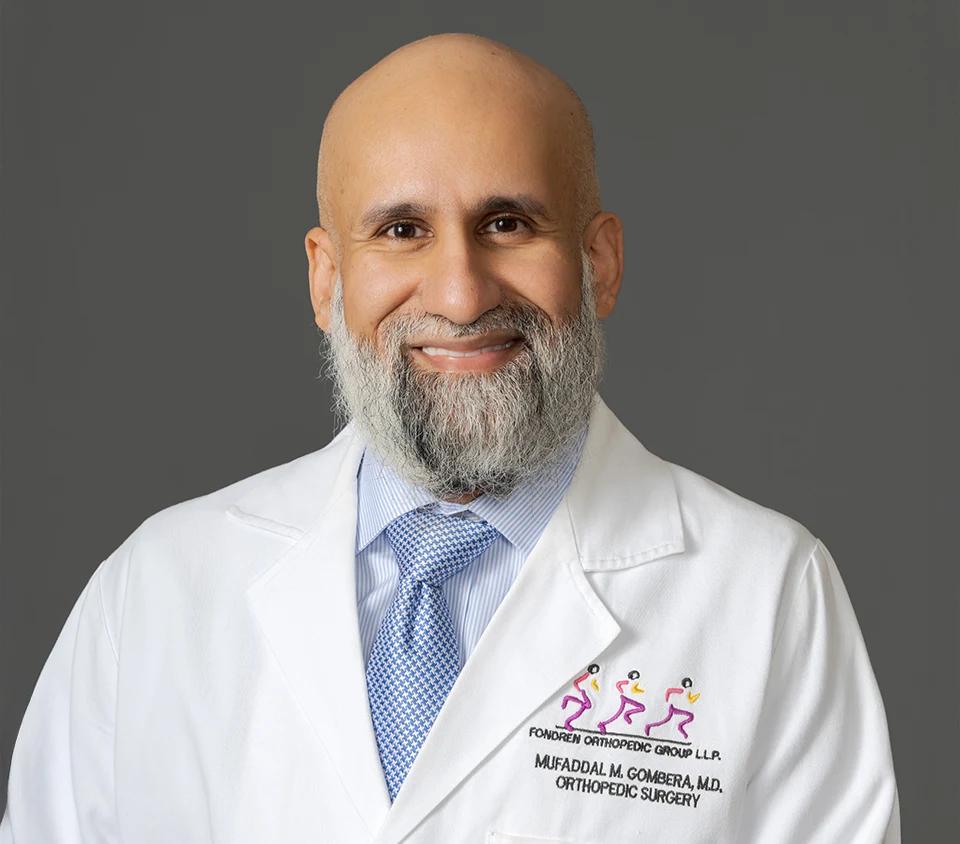
Medically reviewed by Mufaddal M. Gombera, MD, Board-Certified Orthopedic Surgeon.
Some shoulders stay unstable because there is not enough labrum left to repair. Dr. Mufaddal Gombera is board-certified in orthopedic surgery with subspecialty certification in sports medicine and evaluates complex and revision shoulder instability, including patients whose previous labral repairs have failed. When the native labrum is shredded, scarred, or was removed in an earlier surgery, reconstruction with graft tissue can rebuild the ring that keeps the ball centered.
When Labral Repair Is Not Enough
Labrum reconstruction exists for shoulders whose labrum can no longer be repaired: tissue that is shredded, scarred from previous operations, or simply gone. The labrum is the ring of firm cartilage that deepens the socket and anchors the shoulder’s main stabilizing ligaments. A healthy torn labrum can be stitched back, which is what a standard Bankart repair does. But some shoulders arrive without that option:
- One or more previous labral repairs that failed, leaving thin or scarred tissue
- A labrum that was trimmed out (debrided) in an earlier surgery rather than repaired
- Chronic, repeated dislocations that ground the tissue down over years
- Degenerative tissue that will not hold stitches, confirmed at the time of surgery
If any of this describes your shoulder, the underlying condition pages on labral and SLAP tears and shoulder instability give useful background.
What Reconstruction Involves
Reconstruction rebuilds the labrum with graft tissue anchored around the rim of the socket. Dr. Gombera prepares the rim, secures the graft with suture anchors where the native labrum used to sit, and tensions the capsule, the ligament envelope around the joint, to the new ring. The graft recreates the bumper that deepens the socket and gives the ligaments a fixed point to pull against.
This is an uncommon, technically demanding operation, and that is worth saying plainly. It is chosen when the simpler options are genuinely off the table, not as an upgrade to a standard repair.
Honest Expectations
Revision stabilization helps the right patient significantly, but outcomes are, on average, less predictable than first-time repair. The goals are concrete: stop the dislocations, restore confidence in the arm, and return you to work and sport. Most patients get there. Some will still notice a difference between the reconstructed shoulder and one that was never injured, particularly at the extremes of throwing or overhead load. Dr. Gombera would rather tell you that before surgery than have you discover it after, and that candor extends to recommending against reconstruction when it is not the answer.
The Workup Comes First
Every reconstruction candidate gets a full re-evaluation, because a failed stabilization always has a reason. Dr. Gombera reviews your operative reports and prior arthroscopy images, obtains MRI with contrast to map the remaining tissue, and uses CT to measure bone loss on the socket and the ball. Sometimes that workup redirects the plan entirely, toward a bone procedure or a different diagnosis, which you can read about on the shoulder instability surgery. Getting the reason right is the difference between a revision that lasts and a third operation.
Risks, Stated Honestly
The most important risks are recurrent instability and failure of the graft to heal or hold tension. Stiffness is more common after revision surgery than primary repair and is managed with a carefully staged therapy program. Infection, nerve injury, and anchor problems are rare. Your specific risk depends heavily on bone loss, tissue quality, and demands, and Dr. Gombera will walk through those numbers with you as part of his shoulder practice approach to honest patient selection.
Discover Your Ortho Options
Recovery Timeline
- Day of surgery: Home the same day for most patients, with your arm in a sling.
- Weeks 1 to 4: Sling protection while the graft begins to attach to the socket rim.
- Weeks 4 to 8: Guided motion returns gradually, protecting the graft from stretch.
- Months 2 to 4: Progressive strengthening of the rotator cuff and shoulder blade muscles.
- Months 4 to 6: Sport-specific training as strength and control return.
- Month 6 and beyond: Return to contact and overhead sport after testing, often later than after a primary repair.
Every recovery is individualized. You will receive a written protocol, and Dr. Gombera’s team coordinates directly with your physical therapist, in Houston or at home.
When Labrum Reconstruction Is Not the Right Answer
Reconstruction is a revision tool, not a first resort. If your own labrum is torn but the tissue is healthy, an arthroscopic Bankart repair is simpler, proven, and the right first operation. If your instability is driven by missing bone on the socket rim, adding soft tissue will not fix a bone problem; bone-based procedures, covered on our shoulder instability surgery, address that directly. And if your pain comes from cartilage wear rather than instability, the honest conversation is about shoulder arthritis care instead. Dr. Gombera will tell you which problem your shoulder actually has before proposing a solution.
Frequently Asked Question
What is the difference between labral repair and labral reconstruction?
Repair reattaches your own torn labrum to the socket rim with anchors and stitches. Reconstruction replaces a labrum that is missing or too damaged to hold stitches, rebuilding the ring with graft tissue. Repair is the standard first operation; reconstruction is reserved for revision and complex cases.
Where does the graft tissue come from?
Graft options include your own tissue or donor tissue, and the choice depends on your anatomy, prior surgeries, and goals. Dr. Gombera reviews the options, including how each affects recovery, at your consultation.
Can reconstruction fix my failed Bankart repair?
Often, but only after the workup explains why the first repair failed. If the cause was poor tissue, reconstruction makes sense. If the cause was unrecognized bone loss or a missed instability pattern, a different procedure fits better. The evaluation matters more than the operation.
Is recovery longer than after a standard labral repair?
Typically yes. A graft must attach to the rim and mature, so motion and strengthening progress more deliberately, and return to contact or overhead sport commonly lands at 6 months or later. Dr. Gombera sets the pace by healing milestones, not by the calendar.
Can Dr. Gombera review my records if I live outside Houston?
Yes. Many revision instability patients start by sending operative reports and imaging for review before deciding whether to travel. Our team coordinates records collection and scheduling so a single trip can cover the consultation and, when appropriate, surgery. See our out-of-town patients page.
Does insurance cover labrum reconstruction?
Medically indicated stabilization surgery, including revision procedures, is covered by most major insurance plans. Our team verifies your benefits before scheduling and explains any expected costs. See our insurance information page for accepted plans.
Schedule a Revision Instability Consultation in Houston
Dr. Gombera sees patients at Texas Orthopedic Hospital (7401 Main St), the Memorial office (8731 Katy Freeway, Suite 110), and the Baytown office (7718 Garth Rd). Out-of-town patients can begin with a records review.