
Medically reviewed by Mufaddal M. Gombera, MD, Board-Certified Orthopedic Surgeon.
Few knee injuries are as alarming as watching your own kneecap sit somewhere it should not be. Dr. Mufaddal Gombera is board-certified in orthopedic surgery with subspecialty certification in sports medicine, and he treats kneecap instability across its whole spectrum: the first-time dislocation in a teenage athlete, and the kneecap that has slipped so often its owner has stopped counting. The right plan depends on which patient you are, and this page explains the difference.
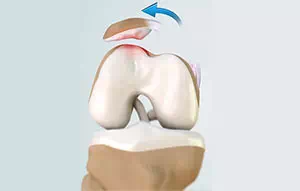
What Is Patellofemoral Instability?
Patellofemoral instability means the kneecap (patella) slips out of the groove it is designed to ride in. The kneecap normally glides up and down a track on the end of the thighbone as the knee bends. When it slides partway out, that is a subluxation. When it comes fully out of the groove, almost always toward the outside of the knee, that is a dislocation. Each episode stretches or tears stabilizing tissue and can scrape cartilage on the way out and back in.
A First-Time Dislocation: What Just Happened
Most first dislocations happen with a twist on a planted foot or a direct blow, often in sports, and most often in teenagers and young adults. The knee buckles, the kneecap visibly sits on the outer side, and it frequently pops back into place when the leg straightens. Swelling follows quickly because torn tissue bleeds.
Two things happen in nearly every full dislocation. The MPFL, the medial patellofemoral ligament, the seatbelt on the inner side of the knee that holds the kneecap centered, tears. And in a meaningful minority, a fragment of cartilage or bone is knocked loose inside the joint. That second possibility is why every dislocation deserves X-rays and usually an MRI: a loose fragment changes the plan immediately, and so does a significant cartilage injury.
Why Some Kneecaps Keep Dislocating
Recurrent instability is usually about anatomy, not bad luck. The risk factors are easiest to understand in plain terms:
- A shallow groove (trochlear dysplasia). The track the kneecap rides in is too flat, like a train rail that has been ironed smooth. There is simply less wall holding the kneecap in.
- A high-riding kneecap (patella alta). The kneecap sits above its groove and only drops in as the knee bends, leaving it unguarded in early bending.
- In some legs, the pull of the thigh muscle and the tendon’s attachment on the shinbone are offset enough that the kneecap gets pulled outward with every contraction.
- Loose ligaments and young age. Naturally flexible patients, and those who dislocate young, recur more often.
- A stretched-out MPFL. Once torn, the ligament often heals loose, guarding poorly against the next slip.
Each additional dislocation risks more cartilage damage behind the kneecap, which is the currency these injuries spend. That accumulating damage, more than the drama of the dislocations themselves, is what drives long-term arthritis risk.
Treatment: Rehab First for Most First-Timers
Most first-time dislocations without a loose fragment are treated without surgery, and that is the evidence-based path, not the timid one. Treatment means a short period in a stabilizing brace, then structured physical therapy focused on the quadriceps and hip muscles that steer the kneecap, followed by a gradual return to sport. A brace with a buttress pad can help during the transition; see the knee brace guide for which type actually fits this problem. Surgery after a first dislocation is mainly reserved for one situation: a loose cartilage or bone fragment that needs to be fixed or removed.
Discover Your Ortho Options
When Surgery Makes Sense
Once a kneecap has dislocated two or more times, each new episode gets more likely and each one risks more cartilage. At that point, patellofemoral stabilization, rebuilding the MPFL and correcting bony anatomy when needed, becomes the reliable way to stop the cycle. Dr. Gombera also considers earlier surgery for patients whose anatomy stacks several risk factors, where the odds of recurrence are high enough that waiting mostly means waiting for more damage. That reasoning is laid out openly at your consultation.
When to See a Doctor
Be seen promptly after any real dislocation, even one that popped back in on its own: imaging needs to rule out a loose fragment. Also get evaluated for catching or locking after a dislocation, a kneecap that keeps slipping or giving way, or a knee that swells after episodes. If the kneecap is still out of place, go to an emergency room to have it put back safely.
Frequently Asked Question
My kneecap popped out and went back in. Do I still need to be seen?
Yes. Nearly every dislocation tears the MPFL, the ligament that holds the kneecap centered, and about a quarter knock loose a fragment of cartilage or bone that needs to be found on imaging. A kneecap that relocated itself still needs an exam and imaging.
Will my kneecap dislocate again?
It depends on your anatomy and age. Risk is highest in younger patients, and in knees with a shallow groove, a high-riding kneecap, or alignment that pulls the kneecap outward. Dr. Gombera assesses those factors to give you a realistic answer, not a generic one.
Does a first-time kneecap dislocation need surgery?
Usually not. Most first-time dislocations without a loose fragment are treated with a short period of bracing and a structured rehab program. Surgery after a first dislocation is mainly reserved for knees with a loose cartilage or bone fragment that needs treatment.
What is the MPFL?
The medial patellofemoral ligament: a band of tissue on the inner side of the knee that works like a seatbelt, holding the kneecap centered in its groove. It tears in nearly every full dislocation, and rebuilding it is the core of stabilization surgery.
Can a brace keep my kneecap from dislocating?
A brace with a buttress pad can support the kneecap and build confidence during rehab, and it is worth using. It cannot change a shallow groove or torn ligament, so for recurrent dislocations it manages the problem rather than fixing it.
Is kneecap instability the same as runner’s knee?
No. Runner’s knee is pain around the kneecap without it slipping out of place, and it almost never needs surgery. Instability means the kneecap physically moves out of its groove. The treatments are different, so telling them apart matters.
Schedule a Kneecap Instability Evaluation in Houston
Dr. Gombera evaluates kneecap dislocations at Texas Orthopedic Hospital (7401 Main St), the Memorial office (8731 Katy Freeway, Suite 110), and the Baytown office (7718 Garth Rd). Same-week consultations are available.