Medically reviewed by Mufaddal M. Gombera, MD, Board-Certified Orthopedic Surgeon
Dr. Mufaddal Gombera is board-certified in orthopedic surgery with subspecialty certification in sports medicine, and his fellowship training at Northwestern University included a focus on the shoulder, including shoulder replacement. He also teaches shoulder surgery to other surgeons, fellows, and residents, including hands-on laboratory instruction. If your shoulder grinds, aches at night, and keeps losing motion, this page explains what is happening and what actually helps at each stage.
What Is Shoulder Arthritis?
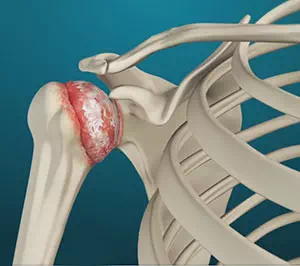
Shoulder arthritis is the progressive loss of the smooth cartilage that lets the ball glide inside the socket, until bone increasingly rubs on bone. As cartilage thins, the joint space narrows and bone spurs build up. The most common type is osteoarthritis, simple wear over time. Arthritis also develops years after fractures or dislocations, from inflammatory disease such as rheumatoid arthritis, and in a pattern called cuff tear arthropathy, where a long-standing massive rotator cuff tear lets the ball ride upward and wear abnormally. The wear pattern determines which replacement, if any, fits your shoulder.
Symptoms of Shoulder Arthritis
Shoulder arthritis typically announces itself as a deep ache with grinding and slowly shrinking motion. Common symptoms include:
- A deep, dull ache in the shoulder, often worse after activity and at night
- Grinding, clicking, or crunching with movement, called crepitus
- Progressive stiffness: reaching behind your back or overhead gets harder each year
- In cuff tear arthropathy, weakness lifting the arm on top of the ache
Stiffness that developed rapidly over weeks, rather than years, may be frozen shoulder instead, a different problem with different treatment.
How Dr. Gombera Diagnoses Shoulder Arthritis
Diagnosis is usually straightforward: an examination plus X-rays tell most of the story. X-rays show the narrowed joint space, bone spurs, and the wear pattern on the socket. A CT scan maps socket bone when replacement is being planned. MRI is added when the status of the rotator cuff is unclear, because an intact cuff versus a torn one is the fork in the road between an anatomic and a reverse replacement.Non-Surgical Treatment: What Helps and What Does Not
Honesty matters most here, because arthritic shoulders attract a lot of overpromising. Nothing non-surgical regrows cartilage. The realistic goals are less pain, kept motion, and postponing surgery as long as it deserves to be postponed.
What genuinely helps:
- Activity modification. Adjusting the loaded and overhead positions that flare pain, without giving up staying active.
- Physical therapy. Maintains motion and strength. It will not fix cartilage, but it keeps the shoulder usable and often meaningfully reduces pain.
- Anti-inflammatory medication. Effective for flares in short courses, with your other health conditions in mind.
- Cortisone injections. Reliable short-term relief for flares and sleep, temporary by nature.
What helps less than advertised: supplements such as glucosamine show little benefit in quality studies, and long sling rest trades pain for stiffness. Heat and ice comfort but change nothing structurally.
Discover Your Ortho Options
A Note on Orthobiologics
Many patients ask about PRP before considering surgery. The honest summary: evidence for orthobiologics in shoulder arthritis is still developing, these injections do not rebuild cartilage, and they are cash-pay treatments. Some patients report months of relief, others little change. Read our straightforward orthobiologics page, and expect Dr. Gombera to tell you plainly whether your joint is too far gone for an injection to be worth your money.When Shoulder Replacement Enters the Conversation
Replacement enters the conversation when pain and stiffness limit daily life despite a fair trial of conservative care, and the decision is yours, not the X-ray’s. Dr. Gombera matches the operation to your anatomy:- Total shoulder replacement. Resurfaces both ball and socket. The standard for advanced arthritis with an intact rotator cuff.
- Partial shoulder replacement. Replaces only the ball, for selected patients, often younger, whose socket cartilage is preserved.
- Reverse shoulder replacement. For cuff tear arthropathy and arthritis with an irreparable cuff, using the deltoid to power the arm.
He will also tell you when replacement is not yet justified, because operating on an X-ray rather than a person is how patients end up disappointed.
When to See a Doctor
See a doctor when shoulder pain or stiffness starts changing how you live: disturbed sleep, avoided activities, or reliance on daily pain medication. Seek earlier evaluation for rapid motion loss over weeks, fever or redness, new weakness, or pain after an old fracture or dislocation. Getting examined does not commit you to surgery; it gives you a baseline, a plan, and honest guidance on timing.
Frequently Asked Question
Can shoulder arthritis be cured or reversed?
No. Worn cartilage does not grow back, and no injection, supplement, or exercise program restores it. That is not hopeless news: symptoms can be managed well for years, and shoulder replacement reliably relieves pain when the joint is truly worn out. Be skeptical of any treatment marketed as regrowing cartilage; current evidence does not support that claim.Will using my arthritic shoulder make it worse?
Reasonable use does not accelerate arthritis, and keeping the shoulder moving preserves motion and strength. Pain, not damage, is the practical guide: activities that flare symptoms for days are worth modifying, while walking, swimming, and light training are encouraged. Complete rest backfires: an arthritic shoulder that stops moving stiffens quickly.How long does a cortisone shot last for shoulder arthritis?
Relief varies widely: some patients get months of benefit, others only weeks. Cortisone treats inflammation, not the worn cartilage, so relief is temporary by nature and tends to shorten with repeat injections. Dr. Gombera uses cortisone strategically and spaces injections apart, especially in the year before any planned replacement.When should I consider shoulder replacement?
When pain and lost function intrude on daily life, sleep, and the activities you care about despite a fair trial of conservative care. Replacement is elective: X-ray severity alone does not require surgery, and waiting while symptoms stay manageable costs you nothing. Most patients know when they are ready, and Dr. Gombera will tell you honestly whether your joint matches your symptoms.What is a reverse shoulder replacement and why would I need one?
A reverse replacement swaps the geometry of the joint: the ball is placed on the socket side and the socket on the arm side. This design lets the deltoid muscle raise the arm when the rotator cuff is torn beyond repair. It is the preferred implant for arthritis combined with a failed or irreparable cuff, called cuff tear arthropathy.Do PRP injections work for shoulder arthritis?
The evidence is still developing and results are mixed. PRP, platelet-rich plasma made from your own blood, may reduce symptoms for some patients, but it does not rebuild cartilage or reverse arthritis, and it is a cash-pay treatment not covered by insurance. Dr. Gombera tells you plainly whether you are a reasonable candidate before you spend money.Closing CTA block
Schedule a Shoulder Arthritis Consultation in Houston
Dr. Gombera evaluates arthritic shoulders at Texas Orthopedic Hospital (7401 Main St), the Memorial office (8731 Katy Freeway, Suite 110), and the Baytown office (7718 Garth Rd). Same-week consultations are available.