Medically reviewed by Mufaddal M. Gombera, MD, Board-Certified Orthopedic Surgeon.
Dr. Mufaddal Gombera is board-certified in orthopedic surgery with subspecialty certification in sports medicine and completed sports medicine fellowship training at Northwestern University. He teaches shoulder techniques to other surgeons as a faculty instructor at the ASES Open and Arthroscopic Techniques in Shoulder Surgery Course. Just as important, he will tell you plainly when a rotator cuff tear does not need surgery, because many never do.
Not Every Rotator Cuff Tear Needs Surgery
Many rotator cuff tears improve without an operation, and any surgeon who suggests otherwise is selling surgery rather than practicing medicine. Partial tears and tears that develop gradually with age often respond well to physical therapy, activity changes, and occasionally an injection. The tendons strengthen, the mechanics improve, and the pain settles. Our rotator cuff tear walks through that conservative ladder in detail.
Repair becomes the right recommendation in specific situations:
- A full-thickness tear after a real injury, especially in an active patient
- Sudden, significant weakness, which suggests the tendon has pulled away and cannot fire
- Pain that persists after several months of quality conservative care
- A painful partial tear that keeps deepening despite therapy
Age matters less than tissue quality and demands. If you are unsure whether your tear needs surgery, that question is exactly what a consultation is for.
How the Repair Works: Anchors and Sutures
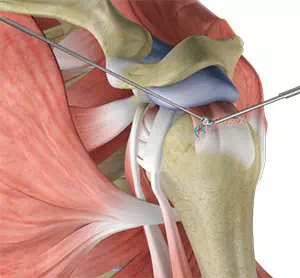
Arthroscopic rotator cuff repair reattaches the torn tendon to the bone it pulled away from, using small anchors and strong sutures. Working through quarter-inch incisions with a camera, a technique explained on our shoulder arthroscopy, Dr. Gombera places anchors into the upper arm bone at the tendon’s natural attachment site, called the footprint. Sutures woven through the tendon then pull it back down and hold it flat against the bone.
For many medium and large tears, he uses a double-row repair: two rows of anchors that press the tendon across the full width of the footprint instead of a single line, recreating the original attachment. During the same procedure he smooths any bone spurs, clears inflamed bursa tissue, and addresses the biceps tendon when it is part of the problem.
Healing Biology: Why the Timeline Cannot Be Rushed
Sutures hold the tendon in position, but healing means the tendon biologically growing back into the bone, and that process takes months. In the early weeks the repair is held by stitches alone, which is why the sling matters and why therapy begins with gentle motion rather than strength work. Push too hard too early and you can pull the repair apart before biology catches up. No surgical technique can shortcut that.
Smoking, diabetes, and the age of the tear all slow tendon healing, and Dr. Gombera will be direct with you about how they affect your odds. Rehabilitation compliance is the patient’s half of the operation: the people who follow the boring parts of the plan are the people who get the good results.
Risks, Stated Honestly
The most important risk is that the repair does not heal, and that risk rises with tear size, tendon quality, and how long the tear existed. Temporary stiffness is common and usually resolves with therapy. Infection, nerve injury, blood clots, and anesthesia problems are rare. Dr. Gombera reviews your individual risk profile before surgery so your decision is based on real numbers for a shoulder like yours, not averages. Rotator cuff repair is one of the most common procedures in his shoulder practice, and honest patient selection is a large part of why it works.
Recovery Timeline
- Day of surgery: Home the same day. Your arm is in a sling, and a nerve block controls most early pain.
- Weeks 1 to 4: Sling on, including overnight. Hand, wrist, and elbow exercises start right away, with gentle passive shoulder motion per protocol.
- Weeks 4 to 6: Sling is weaned during this window. Active motion begins.
- Week 8: Golf returns in limited form: chipping and putting only.
- Months 3 to 4: Progressive strengthening as the tendon-to-bone bond matures.
- Months 4 to 6: Skiing and return to most sports.
- Months 6 to 9:
- By month 9: Normal activities, including heavy lifting, for most patients.
Every recovery is individualized. You will receive a written protocol, and Dr. Gombera’s team coordinates directly with your physical therapist, in Houston or at home.
When Rotator Cuff Repair Is Not the Right Answer
Some tears should not be repaired. Massive, chronic tears with retracted tendon and poor tissue quality fail too often when stitched back; honest alternatives include tendon transfer and reverse shoulder replacement. Long-standing tears in low-demand patients who still function well are often best served by therapy, not an operation; our rotator cuff tear covers that path. And when a chronic tear has already produced arthritis, a pattern called cuff tear arthropathy, repair no longer helps and the conversation shifts to arthritis care and reverse replacement. Dr. Gombera will tell you which category your shoulder is in.
Discover Your Ortho Options
Frequently Asked Question
Do all rotator cuff tears need surgery?
No. Many tears, especially partial tears and tears that developed slowly with age, improve with physical therapy and never need an operation. Surgery earns its place for acute full-thickness tears in active patients, tears causing sudden weakness, and tears that stay painful after a genuine trial of conservative care.
What happens if I delay surgery on a torn rotator cuff?
It depends on the tear. Some stay stable for years, while others enlarge, retract, and lose muscle quality, which makes later repair harder and less reliable. Dr. Gombera rechecks tears being managed without surgery and explains the specific warning signs that should prompt a return visit.
How long will I wear a sling after rotator cuff repair?
Typically about 4 to 6 weeks. The sling protects the repaired tendon while it reattaches to bone, which is the slowest part of healing. Hand, wrist, and elbow exercises begin immediately so the rest of the arm stays mobile while the repair is protected.
When can I drive after rotator cuff repair?
Most patients return to driving once they are out of the sling, off narcotic pain medication, and able to control the wheel confidently with both hands. For many people that lands near the six week mark. Dr. Gombera will clear you based on your progress, not a fixed date.
When can I golf, ski, or throw again?
Golf restarts with chipping and putting at 8 weeks. Skiing and most sports return between 4 and 6 months. Throwing takes the longest, 6 to 9 months, because it loads the repaired tendon hardest. Most patients resume their normal activities by 9 months after surgery.
Can a repaired rotator cuff tear again?
Yes, and honest surgeons say so. Re-tear risk rises with larger tears, older tissue, smoking, diabetes, and doing too much too soon. Technique matters, but so does protecting the repair while the tendon grows back into bone. Following the sling and therapy plan is the part of the result you control.
Does insurance cover rotator cuff repair?
Most major insurance plans cover medically indicated rotator cuff repair. Our team verifies your benefits before scheduling and walks you through any expected costs. See our insurance information page for the current list of accepted plans.
Schedule a Rotator Cuff Consultation in Houston
Dr. Gombera sees patients at Texas Orthopedic Hospital (7401 Main St), the Memorial office (8731 Katy Freeway, Suite 110), and the Baytown office (7718 Garth Rd). Same-week consultations are available.